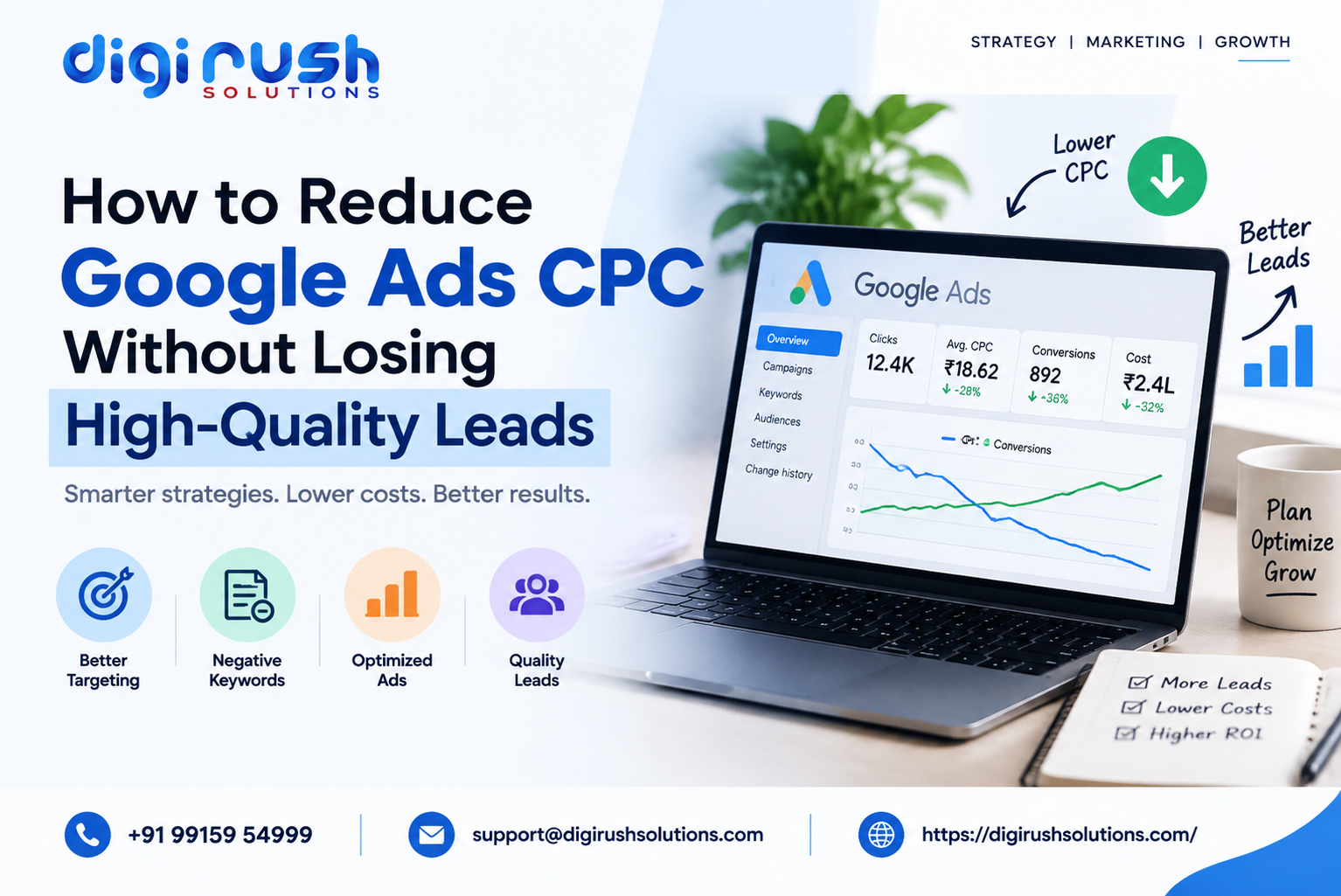
Google Ads can bring customers to your business quickly, but rising cost per click can make campaigns difficult to manage. Many businesses face the same problem. They receive clicks, spend their daily budget, and still struggle to generate enough qualified leads.
Reducing CPC may sound like the obvious solution. However, simply trying to get cheaper clicks can create another problem. You may start attracting people who have little interest in your product or service.
The real goal should be different. You want to reduce Google Ads CPC while keeping lead quality strong.
This requires better targeting, stronger ads, relevant keywords, and a landing page that matches what people are searching for.
Focus on Search Intent Before CPC
Not every low-cost keyword is valuable.
A keyword may cost less because fewer advertisers want it, but it may also attract people who are only researching. These visitors can click your ad without contacting your business.
For example, someone searching:
“how does SEO work”
has a different intention from someone searching:
“SEO agency for small business”
The second search shows stronger buying intent.
Instead of selecting keywords only because they have a lower CPC, look at the reason behind the search. Focus more of your budget on searches that show a clear need for your service.
A slightly more expensive click can still be more profitable if that visitor is more likely to become a customer.
Improve Your Ad Relevance
Google wants users to see ads that are closely connected to their searches.
If someone searches for “local SEO services,” an ad specifically discussing local SEO will normally be more relevant than a general digital marketing advertisement.
Do not use broad ad groups; create focused ad groups by using fewer irrelevant keywords in one ad group.
Your chosen keyword, ad copy, and landing page must talk about the same service.
According to Google, the expected CTR, ad relevance, and landing page experience are considered the three key elements of Quality Score. Hence, relevance may assist you in finding improvements in your campaigns.
Review Your Search Terms Regularly
One of the easiest ways to waste Google Ads budget is to ignore the Search Terms report.
Your keywords and actual customer searches are not always the same.
Suppose you provide professional website design services. Your ad could appear for searches such as:
“free website design”
“website design course”
“website design jobs”
“learn web designing”
These visitors are probably not looking to hire your company.
Check the Search Terms report regularly and identify searches that are spending money without bringing relevant leads.
Google recommends using search-term data to identify irrelevant searches and add suitable negative keywords.
Removing unwanted traffic means more of your budget can go toward potential customers.
Build a Strong Negative Keyword List
Negative keywords are one of the most useful tools for controlling unnecessary clicks.
Depending on your business, examples may include:
free
jobs
career
course
training
tutorial
DIY
meaning
salary
However, do not blindly copy a huge negative keyword list.
A word that is irrelevant for one company may be valuable for another. Review actual search data before blocking important terms.
The purpose is not to reduce traffic as much as possible. The purpose is to remove traffic that has little commercial value.
Use Keyword Match Types Carefully
Broad match can help advertisers discover more searches, but it can also increase the range of queries that may trigger an ad.
Phrase and exact match can provide tighter control when you are working with a limited budget.
This does not mean broad match should always be avoided. Google says broad match can reach additional relevant searches and can work together with Smart Bidding by giving the bidding system more auction opportunities.
The important part is monitoring results.
If broad match produces qualified conversions at an acceptable cost, it can be useful. If it repeatedly attracts weak searches, adjust your keywords, negatives, targeting, or bidding approach.
Improve Your Landing Page Experience
Reducing CPC is not only about changing settings inside Google Ads.
Your landing page matters too.
Someone clicking an ad for “PPC management services” should not arrive on a general homepage where they have to search for information.
Send them to a dedicated PPC service page.
The page should quickly explain what you offer, who the service is for, and how someone can contact you.
Keep the message consistent from the keyword to the ad and then to the landing page. Google specifically recommends making landing pages relevant to user searches and keeping messaging consistent between ads and landing pages.
Also make sure the page works properly on mobile devices and does not make visitors wait unnecessarily.
Write Ads That Filter the Right Audience
Your ad should not only attract clicks. It should attract the right clicks.
Clear ad copy can help filter users before they visit your website.
Instead of writing:
“Best Digital Marketing Company”
you can be more specific:
“Digital Marketing Services for Small Businesses”
This tells the user what you offer and who you serve.
Mention useful details such as your main service, location, consultation options, experience, or unique business advantage when relevant.
More specific messaging may reduce meaningless clicks while encouraging qualified prospects to visit your site.
Optimize Location, Device and Schedule
Look beyond keywords.
Check where your conversions actually come from.
You may discover that one location generates many clicks but very few leads. Another area may generate fewer clicks but much stronger enquiries.
The same principle applies to devices and time of day.
Study your campaign data before making major adjustments.
Avoid removing a location or time period based on only a few clicks. Look for meaningful patterns over enough data.
Better targeting helps prevent your budget from being spent where your strongest customers are unlikely to come from.
Use Conversion Data, Not CPC Alone
A low CPC does not automatically mean a campaign is successful.
Imagine two campaigns.
Campaign A generates clicks for $2 but requires 40 clicks to produce one lead.
Campaign B generates clicks for $4 but produces one lead every eight clicks.
Campaign B has the higher CPC, but it may deliver much better business results.
Track form submissions, phone calls, purchases, bookings, qualified leads, or whichever actions matter to your company.
Once reliable conversion tracking is available, bidding strategies can use more useful information than click cost alone. Google states that Smart Bidding uses auction-time signals to optimize toward conversions or conversion value according to campaign goals.
Test Before Making Large Changes
Google Ads optimization should be continuous.
Test different headlines, keyword groups, landing pages, offers, targeting settings, and bidding approaches.
Do not change everything at once.
If you make ten major changes together, it becomes difficult to understand what actually improved or hurt performance.
Make controlled adjustments and compare the results.
Look at CPC, conversion rate, cost per lead, lead quality, and actual sales instead of focusing on only one metric.
Final Thoughts
Lowering CPC through Google Ads is definitely helpful, but lower costs should never be the ultimate aim of the campaign.
An effective campaign attracts relevant traffic to your website at an appropriate cost.
Refine your keyword intent, eliminate irrelevant searches, enhance your negative keyword list, design better ads, optimize landing pages, and have correct conversion tracking.
More than anything else, measure the success of your campaign by the quality of the business it creates.
The most effective Google Ads campaign is not always the one that attracts the lowest CPCs. It is the campaign that consistently converts your advertising dollars into leads and customers.
Recent Blog